Prime Video Key Art.
Key art adapted for Prime Video launches across European markets.
~200
Assets per title · 6 markets · 2–5 days
- 10–15 titles
- EU5 + NL
- Sole QA
One piece of key art, reshaped into about 200 assets for six European markets, often in under a week.
- Role
- Creative designer (sole designer in London)
- Client
- Amazon Prime Video
- Timeline
- 2023–2025
- Team
- Team lead, overseas production team in Costa Rica, a marketing lead per title
- Tools
- Photoshop, Figma
01Hardcore Never Dies · NL
02Die Teddy Teclebrhan Show · DE
03James May: Our Man in India · UK
01
Problem
Every Prime Video title launched in six European markets: the UK, Germany, France, Italy, Spain and the Netherlands. Each market needed 30–40 assets, from billboards and bus stops to banners and social, so one piece of key art had to become roughly 200 assets. The turnaround was usually two to five days.
The artwork was never designed for most of those shapes.
And every market brought its own rules: German titles often ran much longer than English ones, France required versions without guns, the Netherlands used a different logo lockup, and every call to action changed length with the language.
The scale broke the tooling. Campaign templates in Photoshop could reach 8–10 GB, and switching languages meant manually updating smart objects in files that slowed the machine to a crawl.
02
Audience
I was the only designer in the London office, working with a production team in Costa Rica. My team lead set the content plan, assigned titles and ran final quality control. Each title had a marketing lead, who received my finished assets for launch.
Behind them were the real audience: viewers in six countries, who needed to recognise the show, read the title in their language and see Prime Video’s brand consistently, whether on a phone or a bus shelter.
03
Process
- Fit the art to the master. My team lead’s master deck set out every format. I adapted each title’s key art to it, styling it to hold up across all dimensions.
- Populate the template. The adapted art went into a campaign template as a smart object, generating every size at once.
- Hand-finish each size. Automated placement gets you most of the way; the rest is judgement. I adjusted spacing, added gradients to keep text readable and accessible, and extended backgrounds where the art didn’t quite reach.
- Localise. Titles, copy and logos for each of the six markets, plus the market-specific versions (gun-free art for France, the Dutch logo lockup).
- Quality check and submit. Final review with my team lead, then submission to the title’s marketing lead.
Drop in the key art
A campaign template with 14 of the formats one title needed. Drop the James May key art in and the template fills every frame. Then hand-finish the frames the automation gets wrong, and localise the set.
Key art
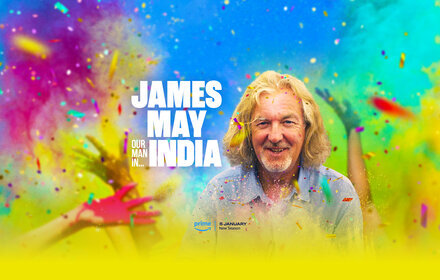
James May: Our Man in IndiaSource key art · 5500 × 3500
Or press Place key art below.
1 · Place
0of 14 frames filled
2 · Hand-finish
Automated placement scales the art to fill each frame, centred.
3 · Localise
Box art frames carry the market’s snipe.
Built from the title’s layered source file: plate, talent cutout, powder, title treatment and the template’s localised snipes. Key art © Amazon.
04
Decisions
- Decision
- Keep talent within the centre of the art, with generous background on every side.
- Trade-off
- Less dramatic framing in the widest and tallest formats. In return, every size needed only minor adjustments rather than a new composition.
- Decision
- Treat market rules as variants, not one-off fixes: gun-free art for France, the Dutch lockup, and copy that changes length in every language.
- Trade-off
- More versions to maintain per title, but no last-minute rework when a market flagged a problem.
- Decision
- Prototyped a Figma-native localisation engine using variables to swap market copy instantly, instead of editing smart objects in 8–10 GB files. I tested it but never ran it on a live campaign. I estimated it would save 5–10 hours per campaign.
- Trade-off
- The team didn’t adopt it. Onboarding everyone to Figma was expensive, Photoshop worked well enough, and Figma couldn’t produce print-quality assets. That was the right call for the team at the time, and it showed me the real blocker was print, not speed.
05
Outcome
- 10–15 titles delivered across six markets, each at roughly 200 assets.
- Earned sole responsibility for QA after establishing a zero-defect track record on later titles.
- A tested prototype showing localisation could be close to instant, even though the team stayed with Photoshop.
06
Next
The variables system wasn’t held back by speed; it was held back by print. So the next thing I’d build is a CMYK-accurate checker and exporter for Figma: the missing piece that would let a team keep instant market switching without giving up print quality.
~200
Assets per title · 6 markets · 2–5 days
10–15 titles, each reshaped into roughly 200 assets for six markets.
- Adaptation
- Creative designer · Corbin
- Key art
- © Amazon
- Client
- Amazon Prime Video
- Tools
- Photoshop · Figma
Loaded: Prime Video Key Art.
Drag the next cartridge into the reader, or press Enter on it · drag the seated one up to eject